Red and Blue Fireworks Burst: A Designer's Review
I have spent years reviewing digital assets for my own boutique and the clients I consult with, so I know that a pretty image on a screen often translates poorly to thread on fabric. That is why I approached Red and Blue Fireworks Burst with a critical eye before committing it to a real project. This isn't just another generic holiday file; it carries a specific energy that demands careful consideration regarding placement, stitch density, and the final visual impact on a finished product.
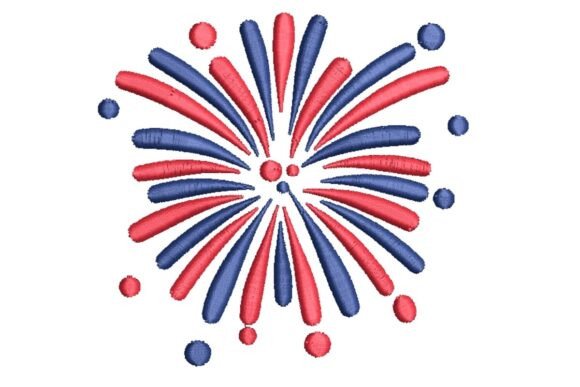
When you first load this design into your software, the immediate impression is one of controlled chaos. The layout features a central explosion of radiating bursts in red and blue, surrounded by smaller circular accents that suggest the lingering sparks of a celebration. It feels dynamic, yet the spacing between the elements suggests it was engineered with the limitations of embroidery in mind. For an Independence Day themed collection or a New Year's Eve event, this design strikes a balance between festive flair and professional polish. It avoids looking like a cheap clipart sticker, which is often the biggest pitfall when using pre-made files for commercial goods.
Real-World Application: From Screen to Stitch
Let me walk you through a scenario where I would actually deploy Red and Blue Fireworks Burst. Imagine I am preparing a custom order for a local craft fair. The client wants a high-end tote bag made from heavy cotton canvas, intended as a premium gift set for a corporate holiday party. They need something that pops but doesn't look cluttered. In this context, the design works beautifully because the radiating lines create a sense of movement that draws the eye across the fabric surface.
However, if I were to use this same file on a small baby onesie, I would have to reconsider. While the theme is perfect for a nursery wall hanging or a baby shower favor, the size of the main burst relative to a onesie chest area might overwhelm the garment unless digitized down significantly. As a designer, I had to ask myself: does this embroidery design hold its shape on a curved surface like a cap? The answer is yes, provided the hoop size is large enough to capture the full arc of the explosion without distorting the outer rings. If placed on a fitted hat, the smaller circular bursts might get lost in the seam allowance or the curvature of the crown.
I also tested the concept mentally on a kitchen towel for a holiday market. Here, the contrast of red and blue threads against white or cream linen would be stunning. The design acts as a focal point, turning a mundane utility item into a decorative piece. But here lies the challenge: Red and Blue Fireworks Burst relies heavily on color separation to define the individual "sparks." If the thread colors chosen are too similar in value, the detail will vanish. You need deep, saturated reds and blues to make the layers distinct. Using pastel threads might result in a muddy, undefined mess rather than a crisp explosion.
Navigating Fabric and Texture Challenges
Not every fabric plays nice with complex radial designs. When working with textured fabrics like terry cloth or boucle, the needle can struggle to penetrate the pile consistently, leading to uneven stitches that ruin the symmetry of the fireworks. Similarly, stretchy knits require a stabilizer strategy that goes beyond the basics. If you do not use a cut-away stabilizer underneath a knit sweatshirt, the tension of the satin stitch used for the outlines could cause the fabric to pucker around the edges of the burst.
Dense stitch areas are another potential headache. The center of the explosion likely has a higher concentration of fill stitches. On thin fabrics, this density can create a stiff, board-like feel that detracts from the softness of the material. I recommend checking the stitch count in your digitizing software before hitting the machine. If the density is too high, the design might look bulky and lose definition. Conversely, on dark fabrics, you must ensure there is enough underlay stitching to prevent the background color from showing through the lighter blue threads. Without proper underlay, the design will look washed out and unprofessional.
Visual Appeal and Brand Consistency
For Etsy sellers and small shop owners, the perceived value of a handmade product is directly tied to the quality of the execution. A well-executed Red and Blue Fireworks Burst elevates a simple tote bag into a statement piece. Customers notice the crispness of the lines and the vibrancy of the colors. It signals that the maker cares about details, which builds trust and justifies a higher price point. However, if the design is stitched poorly—skipping stitches, having loose threads, or misaligned registration—it immediately undermines the brand's reputation.
The design's versatility allows it to fit into various categories of custom apparel and home decor. It works equally well on a denim jacket for a music festival or a pillow cover for a living room during the summer season. The key is ensuring that the scale matches the product. A massive version of the design on a small apron pocket looks awkward, while a scaled-down version on a large blanket might disappear. Always create printable mockups to visualize the proportion before cutting any fabric. This step is crucial for avoiding costly mistakes with expensive materials.
Practical Notes for the Embroidery Designer
Before you rush to start production, there are several technical checks you must perform. First, always test the design on scrap fabric that matches the texture and weight of your final product. This helps you identify potential issues with thread tension or fabric distortion early in the process. Second, review the stitch density settings in your digitizing software. If the file seems too dense for your intended fabric, consider reducing the fill percentage or switching some fill stitches to running stitches to reduce bulk.
Confirm your hoop size capabilities. Some machines struggle with larger hoops, and if the design requires a wide area, you may need to re-digitize it or split it into sections. Check the thread colors available in your inventory; sometimes the specific shades required for the red and blue palette are not standard, requiring you to source specialty threads. Also, inspect the small details closely. The smaller circular bursts around the main explosion are often the first to degrade if the stitch length is too long or the tension is off.
Finally, verify the licensing terms. Many digital embroidery files come with restrictions on how many finished items you can sell commercially. If you plan to use Red and Blue Fireworks Burst for mass-produced merchandise, ensure you have the correct commercial license. Do not assume that a personal purchase allows for unlimited sales. Additionally, test the design in black and white mode within your software to see how the shapes hold up without the distraction of color. This reveals whether the composition is strong enough on its own merit.
In conclusion, Red and Blue Fireworks Burst is a robust choice for anyone looking to add a celebratory touch to their embroidery projects. It offers a strong visual identity that resonates with customers looking for festive, high-quality gifts. By paying attention to fabric selection, stabilizer usage, and precise stitching techniques, you can transform this digital asset into a standout finished product that delights both the maker and the recipient.